

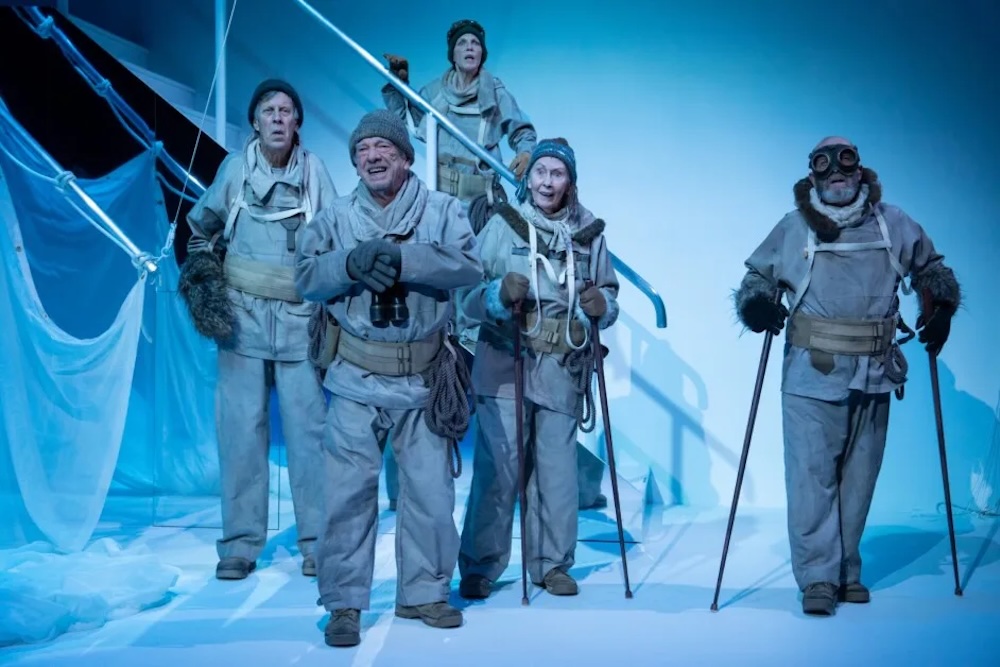
There’s something deeply affecting about watching a group of elderly people turn an aged care home into an Antarctic expedition. In Queensland Theatre Company’s Do Not Go Gentle the residents become explorers battling through a freezing white wilderness, with the routines and indignities of aged care recast as the hazards of a polar journey.
Written by Patricia Cornelius and directed by Heather Fairbairn, Do Not Go Gentle uses the doomed expedition of Robert Falcon Scott as a framework for exploring ageing, dementia, mortality and the stubborn desire to keep hold of yourself as the years begin to take things away.
William Zappa’s Scott acts as the determined centre of the group, guiding his crew through the bitter white wilderness with fierce confidence and grit. There’s a wonderful certainty to his performance, though it is punctured by moments of frailty that reveal the enormous effort beneath Scott’s resolve. He becomes a powerful metaphor for facing mortality, particularly for anyone who has ever decided that the only sensible thing to do in the face of something frightening is to keep putting one foot in front of the other.
Jennifer Flowers brings a glorious warmth to Wilson, who becomes the guiding light of the expedition despite never being its leader. She is jolly, funny and wonderfully disinhibited, particularly in her playful advances towards Scott. Jennifer gives Wilson a terrific sense of freedom. That matters because Wilson’s story is also about reclaiming autonomy. Older women are so often written as though desire has quietly evaporated somewhere around retirement age, yet Wilson remains interested in flirting, intimacy and the pleasures of being alive.
Bruce Spence’s Oates carries a much heavier emotional burden. He is haunted by deep personal trauma, and the eventual revelation of what has shaped him is heartbreaking. Spence is superb at conveying the fear and guilt of a man trying to reconcile himself with decisions he can never change.
Christen O’Leary’s Claudia/Birdie was the character I found hardest to shake. When the cast was first announced, I remember thinking Christen seemed far too young to be playing someone in aged care, and that casting choice becomes increasingly intriguing as Claudia’s story unfolds. Christen gives her a fierce intelligence and an almost combustible energy, with every frustration feeling sharpened by the sense that Claudia has so much more she wants from life.
She is ambitious, opinionated and furious about wasted time, particularly when she sees other people letting theirs slip away. As someone who has also worked as a journalist, I found Claudia’s story uncomfortably close to home, and there were moments where I could feel the character getting under my skin in a way I wasn’t prepared for.
Evans (played by Steven Grives) brings a combustible energy to the group. He responds to the punishing journey with a dry, dark humour about his body’s betrayals. Back in the aged care home, that grumbling takes a sharper turn. Evans is a fierce activist who rails against the indignities of institutional care. His final monologue is visceral. The rage in his delivery keeps building until the very last second. Evans refuses to accept that ageing should mean surrendering your voice.
Andrew Buchanan plays several roles throughout the production, though his scene as Claudia’s husband ripped my heart out. In a small vignette, he captures the particular agony of watching someone you love slip further away from you. A perfectly placed quaver in his voice does an impeccable job conveying a grief that feels intimate, restrained and devastatingly familiar.

Marylin Richardson’s Maria sits outside the Antarctic metaphor. A Serbian immigrant who has lost her homeland, her family and now her mind, she moves around the fringes of the stage while her operatic laments echo through the imagined ice. Richardson has a gorgeous voice, and her songs give Maria’s story an almost ghostly quality.
The set is simple but wonderfully evocative, with huge translucent sails transforming throughout the production into jagged Antarctic mountains, the tents that shelter the residents and other parts of their icy landscape. Mirrors stretch across the back of the stage, and every so often a door appears within them, revealing glimpses of the aged care home or a previous life, like fragments of memory appearing from somewhere just beyond reach. The mirrors are particularly effective, drawing the audience into the strange overlap between the Antarctic fantasy and the world of the home.
From the side of the audience, though, the design creates some frustrating sightline issues. In one scene inside the tent, I could barely see the performers despite the translucent fabric. The way the fabric gathered, combined with the actors facing across the space rather than towards the sides, meant I could see only one person’s face for much of the scene. It was a shame because the design itself is so strong, and those moments of visual obstruction pulled me out of a world that had otherwise been so carefully constructed.
That world is at the heart of what makes Do Not Go Gentle so affecting. The fateful Antarctic expedition becomes a potent metaphor for the final stretch of a life because these characters know, somewhere beneath the fantasy, that they are travelling towards an unavoidable destination. What matters is how they face the journey.
Bring your tissues.
WHAT: Queensland Theatre Company’s Do Not Go Gentle
WHERE: Bille Brown Theatre
WHEN: Until August 30, 2026
TICKETS: Get your tickets to Do Not Go Gentle here.

In her spare time, she likes long walks down the makeup aisle and performing in Brisbane theatre. You can follow her adventures on Instagram and TikTok @thebeautypalate.
